
Blogs
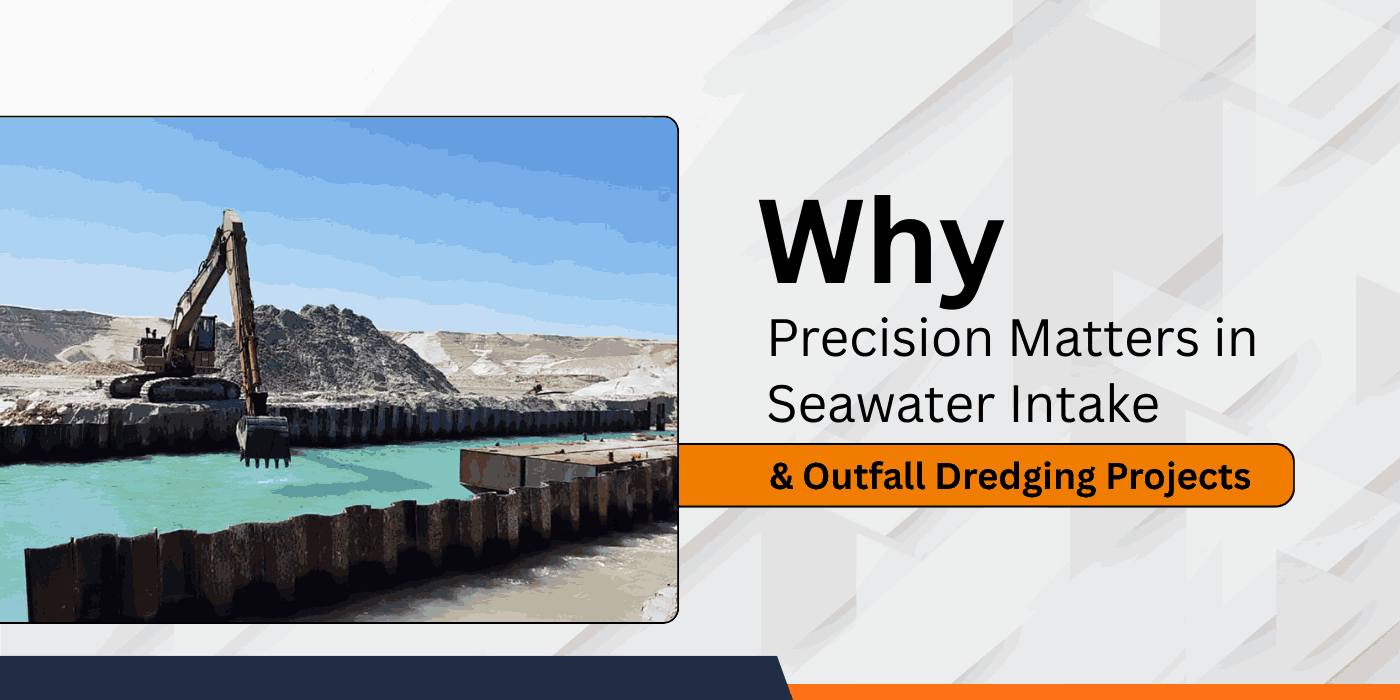
Why Precision Matters in Seawater Intake and Outfall Dredging Projects
Summary
Seawater intake and outfall dredging projects are highly sensitive marine engineering works that directly impact the performance, safety, and lifespan of desalination plants, power plants, refineries, and coastal industrial facilities. This blog explains why precision is critical in seawater intake and outfall dredging projects, the technical challenges involved, and how experienced marine dredging experts ensure accuracy, compliance, and long-term operational reliability through engineered dredging solutions.
Introduction
Seawater intake and outfall systems form the operational backbone of coastal infrastructure such as desalination plants, power stations, and industrial utilities. These systems depend on accurately dredged channels and stable seabed conditions to ensure uninterrupted water flow, efficient discharge, and environmental safety.
Unlike conventional dredging, seawater intake and outfall dredging demands exceptional precision. Even minor deviations in depth, alignment, or slope can lead to operational failures, excessive maintenance, or environmental non-compliance. This is why such projects require proven marine dredging expertise rather than standard excavation practices.
As specialists in dredging and marine engineering, Rock and Reef Dredging Pvt. Ltd. executes seawater intake and outfall dredging as a precision-driven engineering solution, aligned with design intent and long-term asset performance.


Table of Contents
- Understanding Seawater Intake and Outfall Dredging
- Why Precision Is Critical in Intake and Outfall Systems
- Key Technical Challenges in Seawater Intake Dredging
- Precision Requirements for Outfall Dredging
- Risks of Inaccurate Dredging in Intake and Outfall Projects
- How Experts Achieve Precision in Marine Dredging
- Equipment and Methodology for Controlled Dredging
- Environmental and Regulatory Considerations
- Why Expertise Matters for Coastal and Industrial Projects
- Conclusion
1. Understanding Seawater Intake and Outfall Dredging
Seawater intake dredging involves creating and maintaining channels that allow clean seawater to flow into intake structures. Outfall dredging focuses on providing stable discharge paths for treated water or effluents back into the sea.
Both systems must:
- Maintain consistent flow conditions
- Prevent sediment ingress or blockages
- Protect intake structures and pipelines
- Comply with environmental and coastal regulations
Precision in dredging ensures these objectives are met throughout the project lifecycle.
2. Why Precision Is Critical in Intake and Outfall Systems
Seawater intake and outfall systems are designed with strict hydraulic and structural parameters. Any deviation during dredging can disrupt system performance.
| Precision Parameter | Impact on System Performance |
| Channel depth accuracy | Prevents air entrainment and flow restriction |
| Proper alignment | Ensures uniform water velocity |
| Stable seabed slope | Avoids sediment collapse and re-siltation |
| Controlled excavation | Protects pipelines and intake structures |
This level of accuracy can only be achieved through experienced marine dredging execution.
3. Key Technical Challenges in Seawater Intake Dredging
Intake dredging projects face unique challenges, including:
- Fine sediment movement near shorelines
- Wave and tidal action affecting excavation accuracy
- Limited working windows due to marine conditions
- Proximity to sensitive intake pipelines and structures
Experts address these challenges through detailed surveys, phased dredging, and real-time monitoring.
4. Precision Requirements for Outfall Dredging
Outfall dredging requires equally high precision to ensure safe dispersion of discharged water. Incorrect dredging can lead to backflow, seabed erosion, or environmental violations.
Precision outfall dredging ensures:
- Proper dispersion zones
- Stable seabed conditions around diffusers
- Long-term structural protection of outfall pipelines
This makes dredging an integral part of the overall marine engineering design.
5. Risks of Inaccurate Dredging in Intake and Outfall Projects
Lack of precision in dredging can create serious operational and financial risks:
| Risk | Potential Consequence |
| Excessive siltation | Frequent shutdowns and maintenance |
| Misaligned channels | Reduced system efficiency |
| Pipeline exposure | Structural damage and safety hazards |
| Regulatory non-compliance | Project delays and penalties |
Precision dredging mitigates these risks from the outset.
6. How Experts Achieve Precision in Marine Dredging
Experienced dredging contractors apply a structured, solution-driven approach that includes:
- Detailed hydrographic and bathymetric surveys
- Accurate dredging design interpretation
- Controlled excavation sequences
- Continuous depth and alignment verification
This ensures dredging aligns perfectly with intake and outfall engineering requirements.
7. Equipment and Methodology for Controlled Dredging

Precision dredging depends on selecting the right equipment and methodology:
- Backhoe dredgers for controlled excavation near structures
- Hopper barges for efficient sediment handling
- Support vessels for stable marine operations
Here, dredging equipment functions as an engineered tools, delivering accuracy rather than volume alone.
8. Environmental and Regulatory Considerations
Seawater intake and outfall dredging projects operate under strict environmental oversight.
Precision dredging minimizes:
- Disturbance to marine ecosystems
- Uncontrolled sediment dispersion
- Risk of environmental non-compliance
Expert execution ensures projects meet regulatory approvals without compromising performance.
9. Why Expertise Matters for Coastal and Industrial Projects
Seawater intake and outfall systems are long-term assets. Precision during dredging directly affects:
- Operational reliability
- Maintenance frequency
- Environmental sustainability
Experienced marine dredging experts anticipate challenges and deliver solutions that support asset longevity.
10. Conclusion
Precision is not optional in seawater intake and outfall dredging projects it is fundamental. From hydraulic performance to environmental compliance, every aspect of these systems depends on accurate dredging execution.
By treating dredging as a marine engineering solution, experienced specialists ensure seawater intake and outfall systems operate efficiently, safely, and sustainably throughout their lifecycle. This precision-driven approach is what separates reliable marine infrastructure from recurring operational challenges.
